Look Up: A Celestial Drama Towards its Next Act
Look up, because this year, a star that hasn’t been seen to the unaided eye since the 1940s will briefly emerge in our night sky. The bright spot of light is the result of a nova, or outburst, from the T Coronae Borealis (T CrB) star system. T CrB has fascinated astronomers for many generations who have watched, tracked, or read about it, leading to T CrB viewers noting a drop in brightness last April. Dr. Rebekah Hounsell, an assistant research scientist specializing in Nova events at NASA’s Goddard Space Flight Center in Greenbelt, Maryland, says it’ll fuel the next generation of scientists.
T CrB’s story unfolds over an extraordinary 80-year cycle. During this time, the star system remains relatively stable until it suddenly flares up, increasing in brightness by thousands of times. But why does this happen?
T CrB is a white dwarf and a red giant binary star system. The red giant ages and loses its outer layers, ending up as a white dwarf. The white dwarf gains this mass over decades, becoming heavier and more compressed, resulting in a buildup inside the white dwarf. Its surface pressure and temperature eventually approach a critical threshold, which sets off a thermonuclear explosion of the hydrogen that was collected. Thus, a transient explosion of light eclipses the red giant companion in brightness, which is what will be seen on Earth as a bright, pulsing star in the night sky.
In contrast to most cosmic explosions, the eruption of T CrB serves as a radical reset. The white dwarf just blasts off the extra material, sending the accumulated material hurtling into space in a blinding flash. This event doesn’t destroy it, so the entire cycle can restart, allowing astronomers to repeatedly watch this cosmic drama play out.
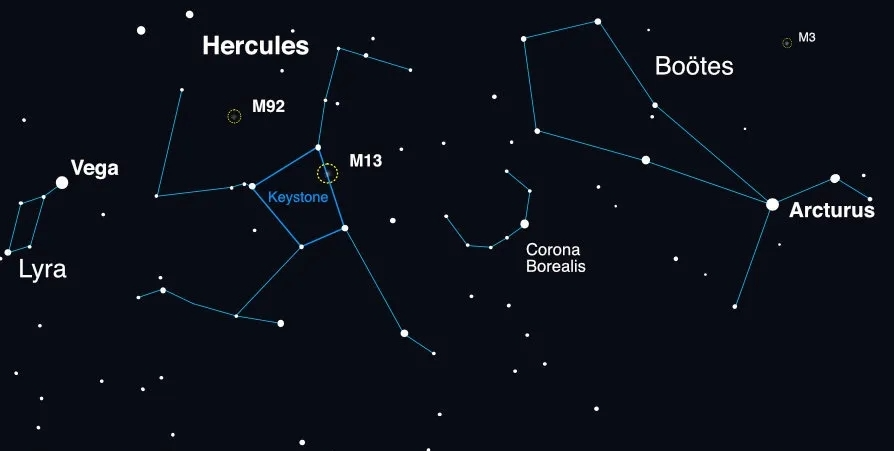
For the stargazers ready to observe T Coronae Borealis’ forthcoming outburst, the first step is to identify its celestial stage: the constellation Corona Borealis, popularly known as the Northern Crown. This constellation features a horseshoe-shaped pattern of stars and may be seen on clear evenings west of the well-known Hercules constellation. To find T CrB, seek brighter stars like Arcturus and Vega, which are among the brightest in the Northern Hemisphere. If you envision a line connecting them, it will lead you to the location of the Northern Crown, which is Hercules. Watch for the spectacular change of T CrB from a faint star to a brilliant nova in this horseshoe pattern.
“It’s a once-in-a-lifetime event that will create a lot of new astronomers out there, giving young people a cosmic event they can observe for themselves, ask their questions, and collect their data,” said Dr. Rebekah Hounsell, an assistant research scientist specializing in nova events at NASA’s Goddard Space Flight Center in Greenbelt, Maryland. “It’ll fuel the next generation of scientists.”
References
https://earthsky.org/tonight/in-a-dark-sky-look-for-the-northern-crown/

- Cultural Perspective of the Moon in East Africa - January 8, 2026
- Reframing Cultural Astronomy in Africa - September 25, 2025
- Enigmatic Explosions Redefining Our Understanding of Cosmic Phenomena - October 14, 2024