
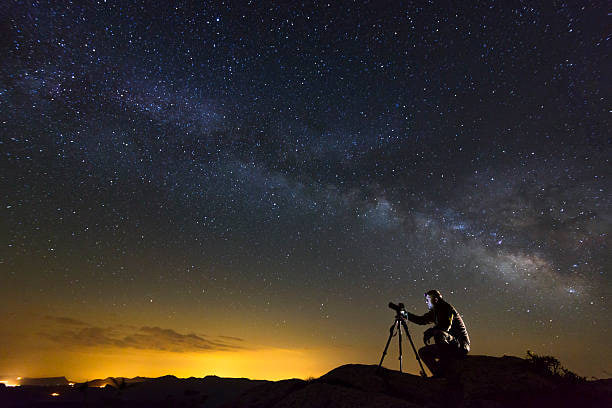
How to Observe the Night Sky
Observing the night sky is one of the most accessible and inspiring ways to explore astronomy, and it does not require expensive equipment or advanced knowledge to begin. With curiosity, patience, and a clear view of the sky, anyone can start learning about the universe from their own location. The first step is choosing the right time and place. Dark skies are essential, so it is best to observe away from strong city lights whenever possible. Open areas such as rooftops, fields, or places with a wide horizon view allow for better visibility. Clear, moonless nights usually provide the best conditions because the sky appears darker and faint stars become easier to see.
Before observing, it is important to allow your eyes to adjust to the darkness, a process known as dark adaptation, which can take around 15 to 30 minutes. During this time, avoiding bright lights and phone screens helps your eyes become more sensitive to faint celestial objects. Starting with the naked eye is highly recommended for beginners because it helps you naturally recognize patterns in the sky, such as bright stars, constellations, and the Moon. Learning to identify major constellations builds a strong foundation and makes future observations more meaningful.
Using a star map or an astronomy app can greatly improve the experience by helping you identify stars, planets, and constellations in real time. These tools make sky observation more interactive and educational, especially for beginners who are still learning how to navigate the night sky. The Moon and visible planets are excellent starting targets because they are bright and easy to locate. The Moon’s phases and surface features change over time, while planets like Venus, Jupiter, and Saturn appear as steady lights that do not twinkle like stars.
As interest grows, binoculars can be introduced before investing in a telescope. Binoculars are simple to use, portable, and capable of revealing more details such as lunar craters, star clusters, and some deep-sky objects. Observing regularly also helps you notice how the sky changes throughout the year, since different constellations appear in different seasons due to Earth’s orbit around the Sun. Keeping a small observation journal can make the experience more engaging and help track what you observe over time.
Most importantly, observing the night sky requires patience and consistency. Even short observation sessions can improve your ability to recognize celestial objects and patterns. Beyond being a scientific activity, stargazing is also a calming and reflective experience that connects you to the vastness of the universe and centuries of human curiosity. With simple preparation and regular practice, observing the night sky can become a meaningful habit that deepens both knowledge and appreciation of the cosmos.

- Your Ultimate Guide to the June Sky Events - May 23, 2026
- Ripples in spacetime and how LIGO proved Einstein right - May 20, 2026
- Hubble Observes A Rare Transitional Galaxy - May 19, 2026
