What is a Black Hole?
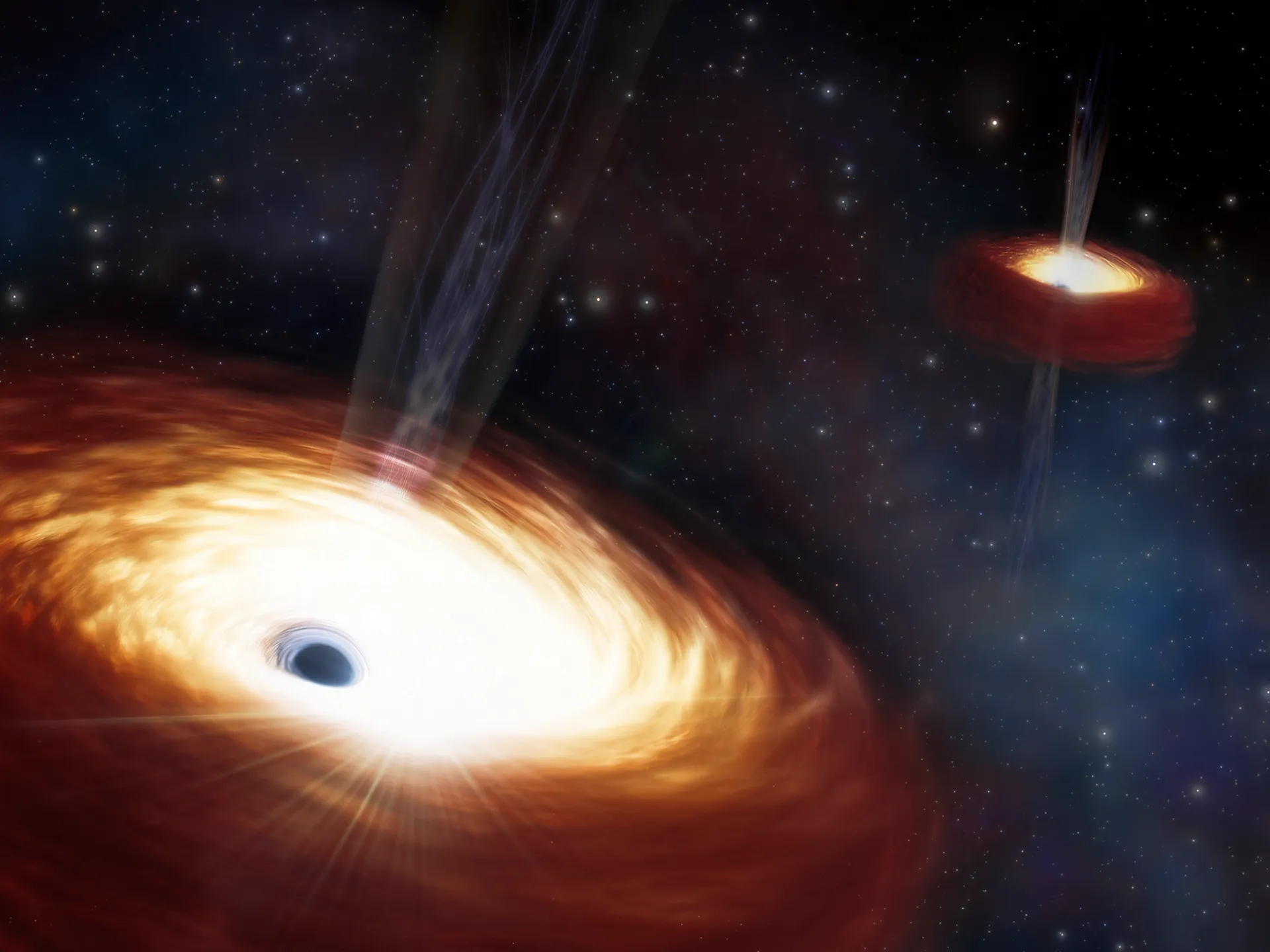
A black hole is a region in space-time where gravity is so intense that nothing, not even light, can escape. Although black holes are often portrayed as cosmic vacuum cleaners that relentlessly consume all matter around them, this characterization is scientifically inaccurate. The reality is that black holes do not pull in matter any more than other massive celestial bodies. If the Sun were replaced by a black hole of the same mass, planetary orbits would not change, and the only effect would be a decrease in planetary surface temperatures, as the primary source of heat and solar energy is lost.
Black holes do not emit any light. Therefore, they cannot be observed directly like other astronomical bodies. Astronomers have devised ways to identify black holes. The most common methods include observing the radiation emitted by accretion disks and detecting the shadow black holes cast on their surroundings. The technology needed for these observations was only developed in recent years. For this reason, black holes were not widely accepted as physical entities until concrete observational evidence proved their existence.
Discovery of Black Holes
The existence of black holes was first discussed by Michell and Laplace in the 18th century, but it was not until the efforts of physicists Einstein and Schwarzschild that it became a true theoretical prediction. In 1939, Oppenheimer and Snyder described the gravitational collapse of a massive star that produces a black hole, laying down the beginnings of black hole astrophysics. These astronomical objects were referred to as “frozen” or “collapsed” stars, but this point of view proved to be restrictive. The work of Oppenheimer and Snyder showed that an observer on the surface of a collapsing star sees no “freezing” at all, as they would be able to register events both inside and outside the gravitational radius. This implied that the object formed could be considered a “hole” in space-time, hence the name “black holes”, which was coined by John Wheeler in 1967.
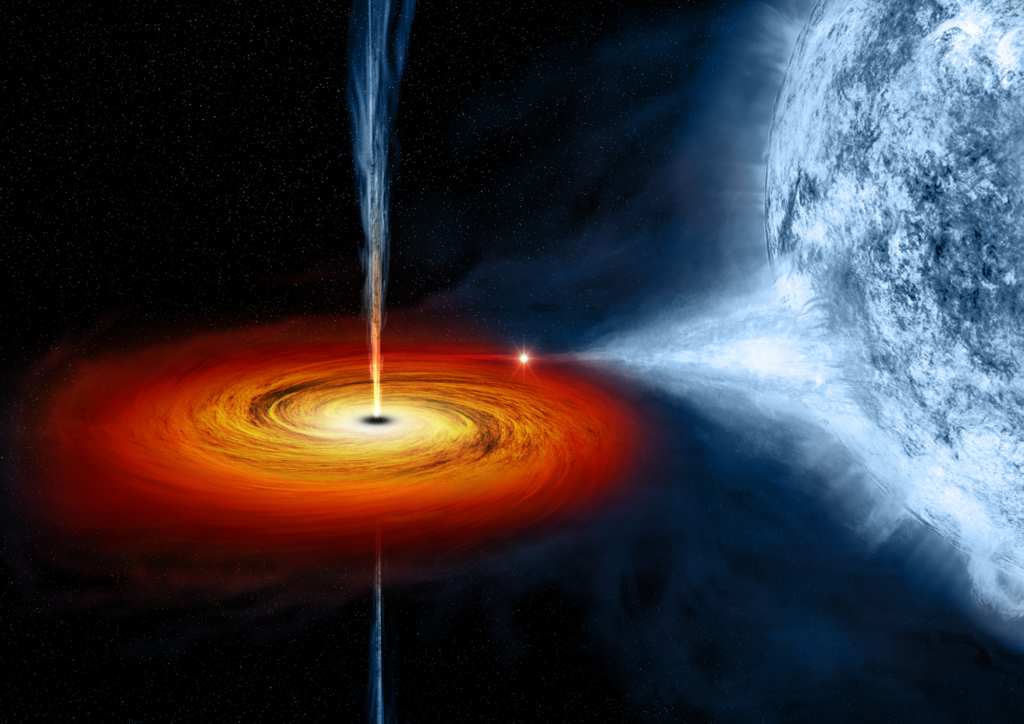
The first piece of evidence for the existence of black holes came from X-ray binaries, most notably from Cygnus X-1, which had been catalogued as a bright X-ray point source in early astronomy. Later observational evidence pointed to the source being a black hole, as intense X-ray radiation was detected, and a companion star seemed to be orbiting a massive invisible object. Additionally, the object’s mass exceeded the theoretical maximum for a neutron star, making a black hole the only viable explanation.
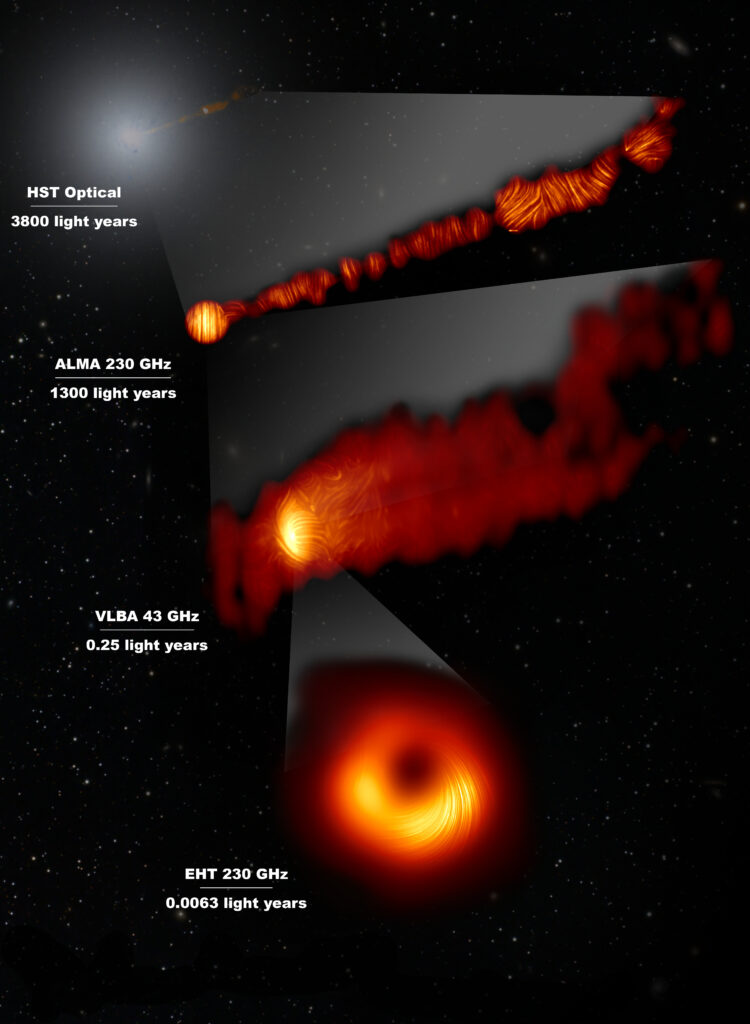
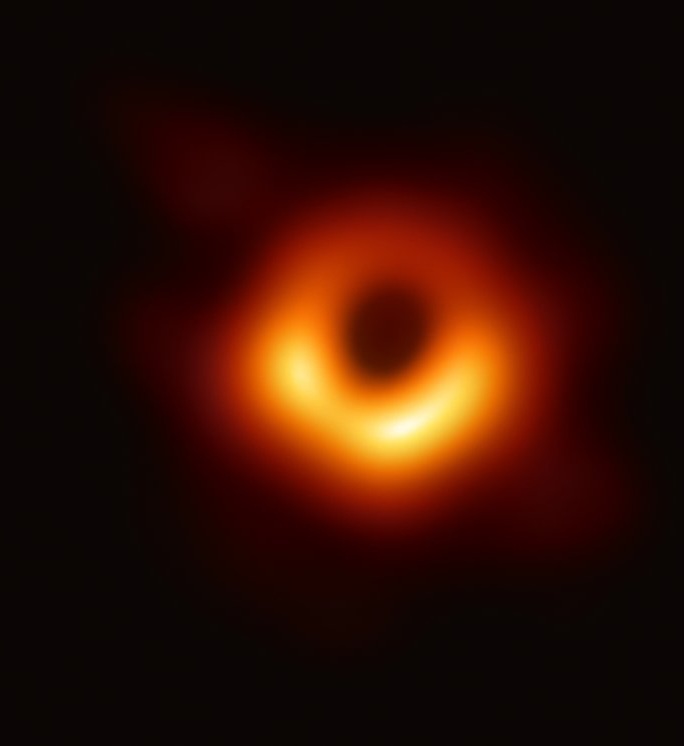
In 2015, the observatories LIGO and Virgo detected the gravitational waves produced by the merger of two stellar-mass black holes, which had caused ripples in space-time. Then, in 2019, the Event Horizon Telescope produced the first image of the shadow of the supermassive black hole M87*. It was the first horizon-scale image that showcased the black hole’s geometry, accurately confirming the predictions of general relativity and serving as visual confirmation for decades of indirect evidence.
The galaxy has a supermassive black hole at its center and is famous for its jets, which extend far beyond the galaxy. The Hubble image at the top captures a part of the jet, some 6000 light-years in size. The values in GHz refer to the light frequencies at which the different observations were made. The horizontal lines show the scale (in light-years) for each image.
The Event Horizon Telescope (EHT), a planet-scale array of eight ground-based radio telescopes created through international collaboration, was designed to capture images of black holes. In coordinated press conferences around the world, EHT researchers announced a historic success: the first direct visual evidence of a supermassive black hole at the center of Messier 87 and its shadow. The shadow seen in the image is the closest representation we can obtain of a black hole itself, as black holes are completely dark objects from which no light can escape. The boundary of the black hole, known as the event horizon, from which the EHT takes its name, is about 2.5 times smaller than the shadow it casts and measures just under 40 billion kilometers across. Although this size is enormous, the black hole appears extremely small from Earth. The ring in the image spans only about 40 micro-arcseconds, which is roughly equivalent to measuring the length of a credit card on the surface of the Moon. While the telescopes in the EHT are not physically connected, they operate in sync using highly precise atomic clocks called hydrogen masers. These clocks allow scientists to accurately time and combine observations collected at a wavelength of 1.3 millimeters during a global campaign in 2017. Each telescope generated vast amounts of data, about 350 terabytes per day, which were stored on high-performance helium-filled hard drives. These data were then transported to specialized supercomputers, known as correlators, at the Max Planck Institute for Radio Astronomy and the MIT Haystack Observatory. There, the data were combined and carefully processed using advanced computational techniques to produce the final image.

"Aim for the moon and even if you miss, you will land among the stars."
– Norman Vincent Peale
- What is a Black Hole? - March 29, 2026