
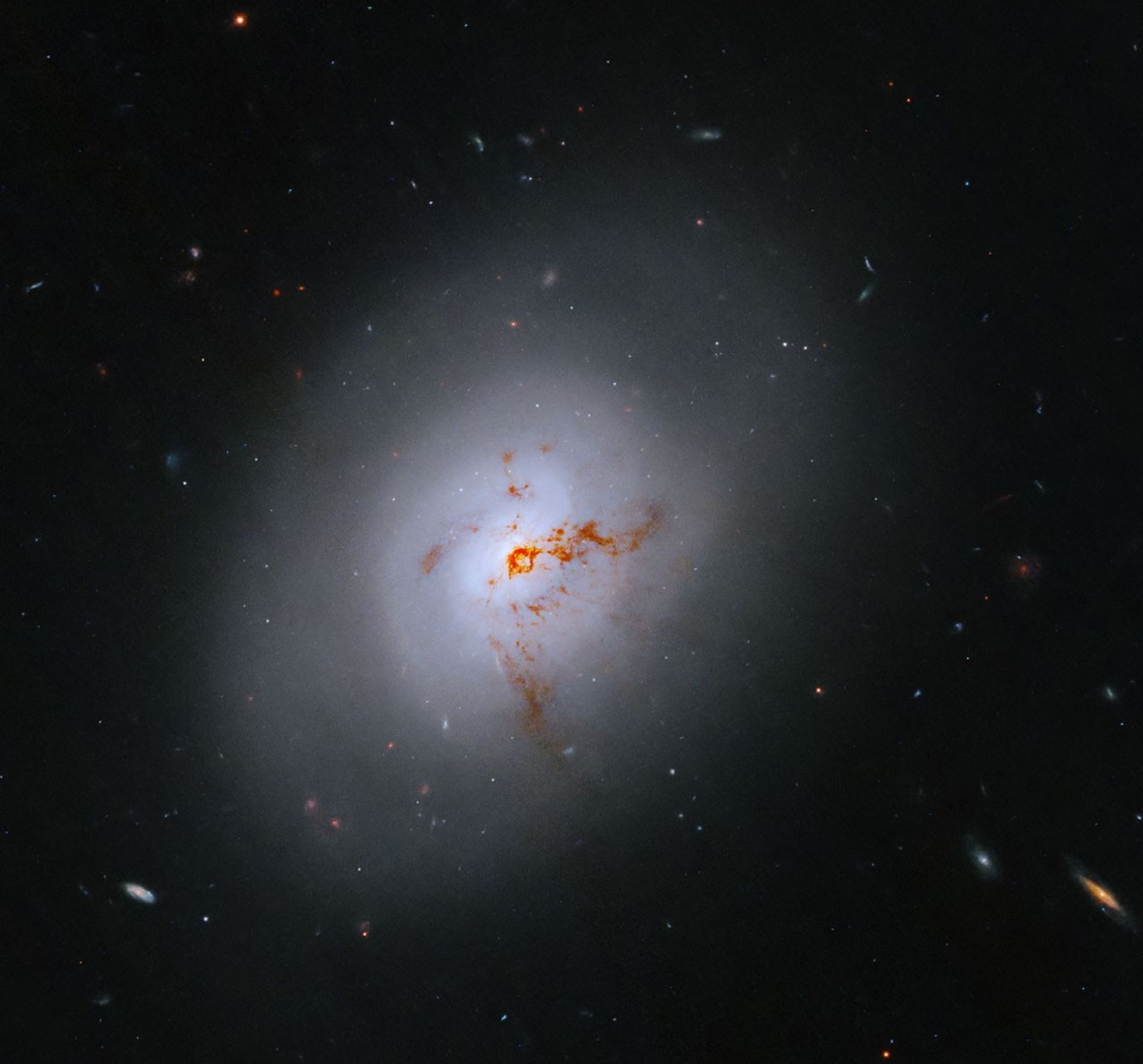
Hubble Observes A Rare Transitional Galaxy
NASA’s Hubble Space Telescope captured a striking image of the lenticular galaxy NGC 1266, which is located 100 million light-years away in the constellation Eridanus. This cosmic structure represents an evolutionary bridge between spiral and elliptical galaxies and features a bright central bulge and flattened disk, but entirely lacks spiral arms.
Astronomers classify NGC 1266 as a rare “post-starburst” galaxy caught in a transitional phase where star formation has abruptly shut down. Data traces this state back to a minor galactic merger roughly 500 million years ago, which triggered a burst of star birth and funneled immense gas into the galaxy’s supermassive black hole.
Supermassive black holes are the largest type of black holes, containing masses equivalent to millions or billions of suns, and they reside at the centers of almost all massive galaxies. When a supermassive black hole actively feeds on massive amounts of infalling gas and dust, it creates an Active Galactic Nucleus, or AGN. An AGN is an extremely bright, energetic central region where intense gravitational and frictional forces heat the swirling matter, causing it to emit vast amounts of radiation across the electromagnetic spectrum.
The active state of the AGN in NGC 1266 generated violent energy jets and powerful winds along its axis of rotation. Hubble observations confirm that these central black hole outflows have severely shocked the surrounding interstellar space. As a result, new star formation has been choked throughout the galaxy and restricted strictly to its core. This offers scientists an ideal frontline subject to study how supermassive black holes manipulate and alter galactic evolution.
Source: NASA

- Your Ultimate Guide to the June Sky Events - May 23, 2026
- Ripples in spacetime and how LIGO proved Einstein right - May 20, 2026
- Hubble Observes A Rare Transitional Galaxy - May 19, 2026