Ripples in spacetime and how LIGO proved Einstein right
The first gravitational waves detected by the Laser Interferometer Gravitational-Wave Observatory(LIGO) were on September 14, 2015. This moment was a big step towards the study of black holes and other sources, and, beyond the scientific advancement, it confirmed Einstein’s prediction from 100 years ago.
Before we dive into what LIGO is and how it functions, we should talk about Einstein’s prediction about gravitational waves. In 1915, Einstein published his Theory of Relativity. In his theory, he predicted the existence of gravitational waves. He proposed that when two massive, dense objects collide and accelerate, they create a wave-like ripple in spacetime around them.
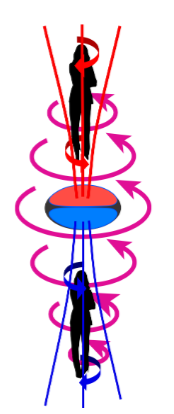
When two, let’s say, black holes merge, they create a whirling twisted motion around them. To explain this in a better way, we can use Kip Thorne’s explanation of this effect from his paper, “The Most Luminous Objects in the Universe, But No Light!” Let’s imagine two people are hanging around the black hole’s poles. The top person’s feet are closer to the hole than her head, so they get dragged by the hole’s whirling space (purple arrows) faster than her head. As a result, her head sees her feet dragged counterclockwise (lower red arrow), and, remarkably, her feet see her head dragged counterclockwise (upper red arrow). It’s like wringing water out of a wet towel; your left hand sees your right turn counterclockwise, and your right hand, looking at your left, sees it turn counterclockwise. In this sense, the whirling space at the hole’s north pole has a counterclockwise twist.
This twist is guided and controlled by vortex lines. These lines extend out of the black hole’s poles. Each vortex sloshes back and forth between clockwise twist and counterclockwise, and with each slosh, the hole throws off a toroidal vortex ring that resembles a smoke ring. As these rings travel outward, they become gravitational waves.
Now comes the question: how can we measure these ripples? This is important because the gravitational waves we get provide information about the colliding black holes, the behavior of gravity in such extreme events, and give us a window to learn more about the early universe by adding hearing to sight!
The concept of the Laser Interferometer Gravitational Wave Observatory(LIGO) was first proposed by Theoretical physicist Kip Thorne at Caltech, physicist Rai Weiss at MIT, and Experimental physicist Ron Drever at Caltech.
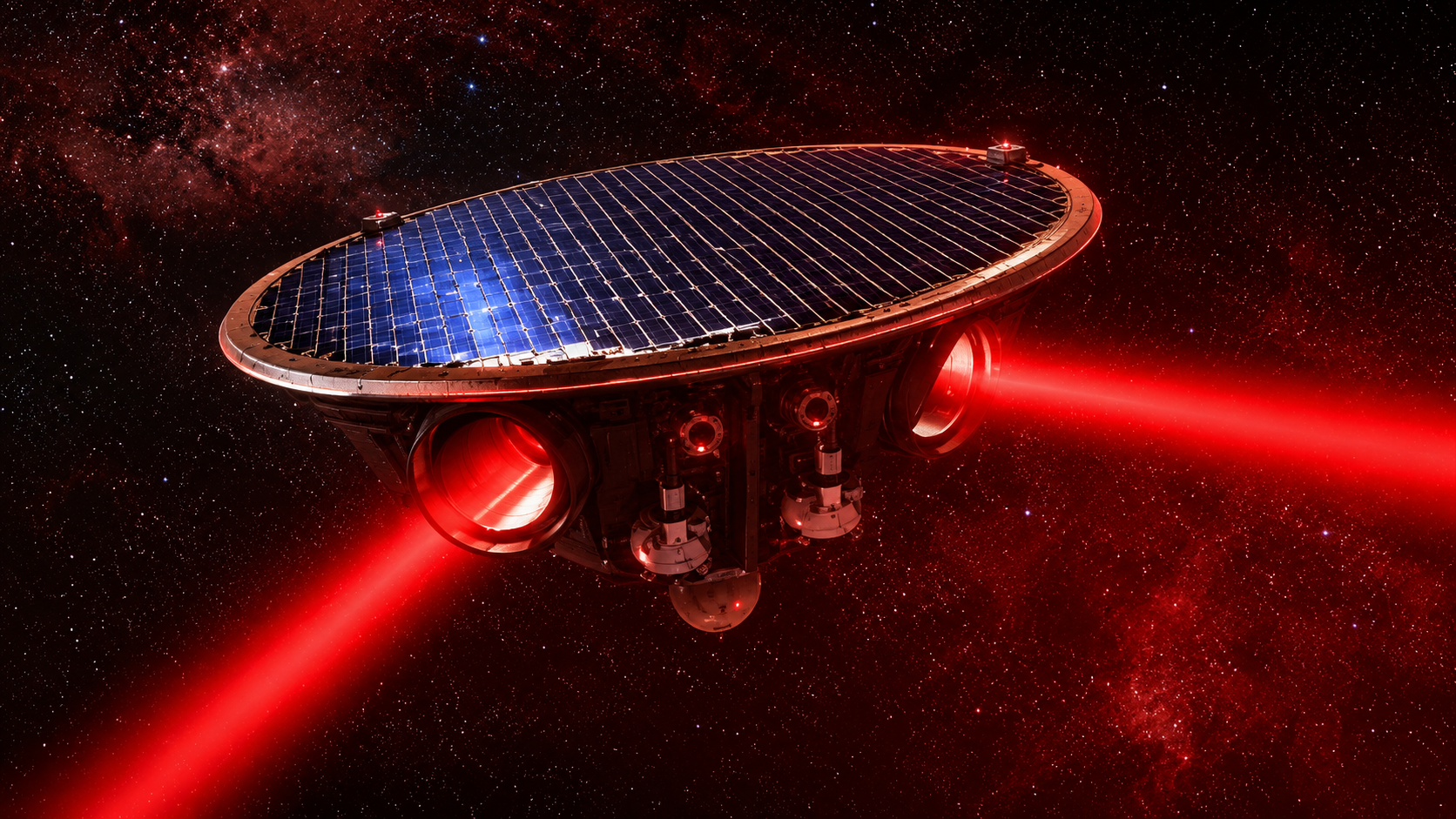
To detect gravitational waves, the mirrors of the Laser Interferometer Gravitational-Wave Observatory (LIGO) must measure a change in distance smaller than one ten-thousandth of the diameter of a proton. Rather than being passive glass reflections, these mirrors, known as test masses, act as active, ultra-pure free-falling anchors engineered to interact flawlessly with laser light while ignoring the physical noise of the rest of the planet.
A passing gravitational wave doesn’t physically “push” the mirrors with a force; it dynamically stretches and squeezes space-time itself. To sense this distortion, the 40-kilogram mirrors must be isolated from Earth’s crust. They are suspended as the final stage of a massive quadruple-pendulum system. To the laser light traveling down the 4-kilometer arms, the mirrors behave as if they are in absolute free-fall in a vacuum, allowing them to move purely with the ripple of a passing wave.
But when this idea was first proposed by Rai Weiss, Kip Thorne tells us in his paper that he was skeptical, and honestly, that comes from a valid point. How can LIGO’s mirrors detect a movement as small as 10^-17 centimeters? Now we know LIGO splits a single laser beam into two and sends them down perpendicular 4-kilometer arms. When the beams return and recombine, they are timed to destructively interfere, meaning the peaks of one wave line up with the troughs of the other, canceling each other out so no light reaches the detector. If a gravitational wave stretches or squeezes the arms by even 10^-17 cm, the beams fall out of sync, and a tiny flicker of light is detected.
A century after Einstein’s prediction, the twin detectors of the Laser Interferometer Gravitational-Wave Observatory (LIGO) proved the theory correct. At 9:50 a.m. UTC, the observatories in Livingston, Louisiana, and Hanford, Washington, detected a brief, faint disturbance. The signal was caused by the cataclysmic collision and merger of two massive black holes located about 1.4 billion light-years away. The black holes (weighing about 36 and 29 times the mass of the Sun) merged into a single, massive spinning black hole. As the black holes spiraled into one another, they released immense energy in the form of gravitational waves. The gravitational wave detected was given the name GW150914 ( named using the year, month, and date of detection). The LIGO instruments were able to measure changes in the length of their 4-kilometer laser tubes that were smaller than 1/1000 the width of a proton!
LIGO continues to be one of the leading observatories that are shaping our understanding of our universe by being the eyes and ears of small ripples in the fabric of space-time and behaving quantum mechanically despite their huge size. You can learn about LIGO and its recent detections at LIGO LAB | Caltech.

- Your Ultimate Guide to the June Sky Events - May 23, 2026
- Ripples in spacetime and how LIGO proved Einstein right - May 20, 2026
- Hubble Observes A Rare Transitional Galaxy - May 19, 2026