
Constellations: From Ancient to Modern Astronomy
Last Updated on March 8, 2026 by Tsiyon Hone
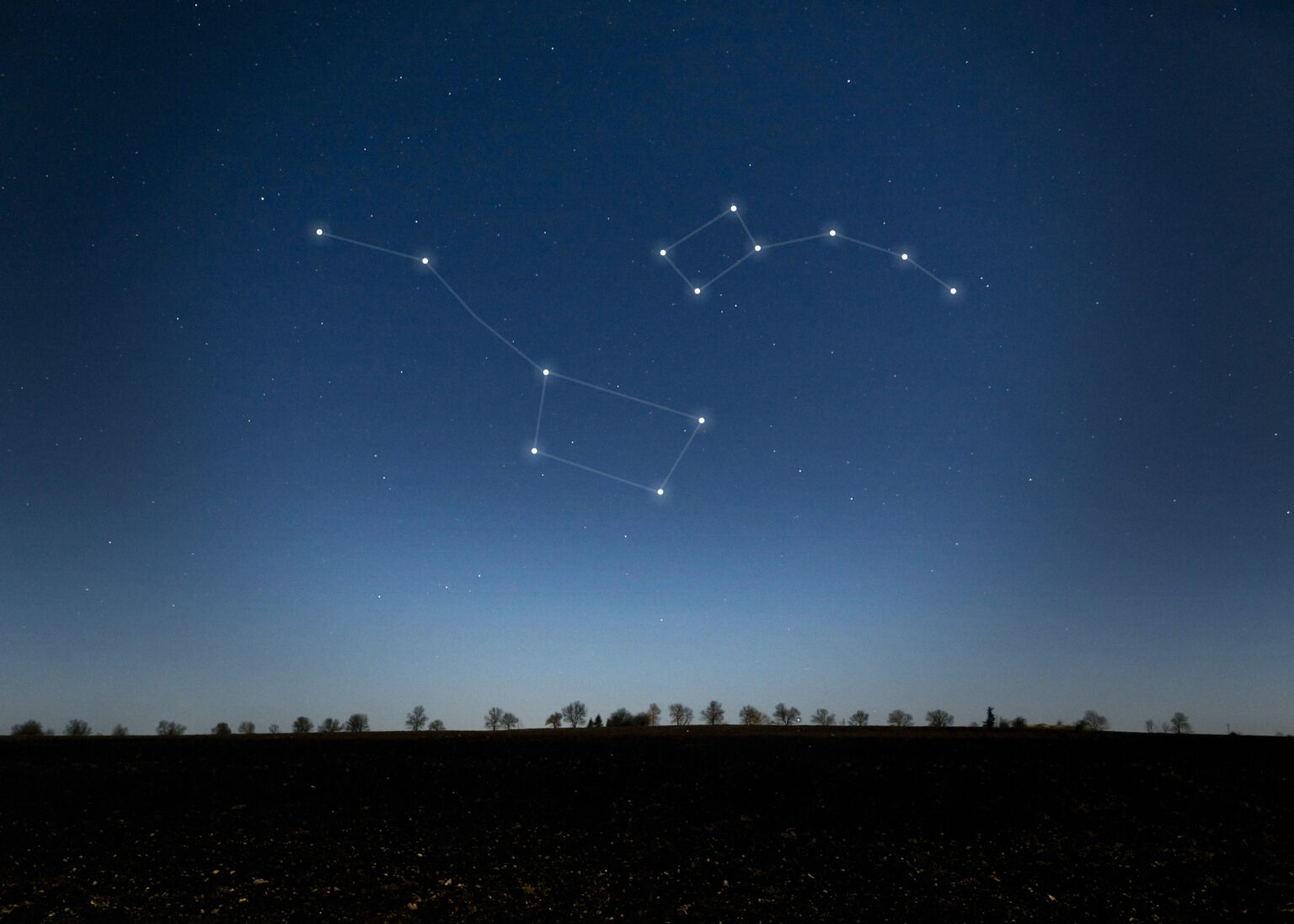
Constellations are groups of stars that, when viewed from Earth, appear to form recognizable patterns. Though these stars may look close together in the night sky, they are often separated by vast distances in space. The shapes we see are illusions of perspective, not physical connections, yet they have carried meaning for humanity across cultures and centuries.
For ancient civilizations, constellations were more than just patterns; they served as guides, calendars, and storytellers. Long before written records or advanced instruments, people looked to the stars to track time, mark the seasons, and navigate across land and sea. The sky became a universal reference point, and constellations served as tools for survival and symbols of identity. They helped communities predict seasonal changes, organize agricultural cycles, and preserve myths and traditions through oral storytelling.
Greek mythology gave us many of the constellations still recognized today. Orion, the mighty hunter, Andromeda, the chained princess, and Cassiopeia, the proud queen, are just a few examples of figures immortalized in the heavens. For the Greeks, these constellations were lessons written in the stars, blending astronomy with morality and myth. Roman scholars later adopted and preserved these stories, and ensured their survival into modern times.
In Egypt, astronomy was deeply tied to religion and the afterlife. Orion was associated with Osiris, the god of rebirth, while the rising of certain stars coincided with the annual flooding of the Nile. Egyptian architecture also reflected this celestial devotion, with pyramids aligned to specific stars, showing how astronomy shaped both spirituality and engineering.
Ethiopia, too, has a rich tradition of indigenous astronomy that is often overlooked. Ancient Ethiopians used the stars to guide planting and harvesting, track rain cycles, and measure time long before mechanical clocks. Astronomy was woven into daily life, religion, and oral knowledge, passed down through generations as a practical and cultural compass.
Today, constellations serve a different purpose. In 1922, the International Astronomical Union officially standardized the sky into 88 constellations, each with fixed boundaries. Modern astronomers now utilize them as maps, enabling the precise location of galaxies, nebulae, and exoplanets. What was once myth and mystery has become a framework for scientific exploration, yet the wonder remains.
Constellations remind us that the night sky is both a scientific chart and a canvas of human imagination. They connect us to our ancestors, who saw stories in the stars, and to our future, where those same stars guide discoveries far beyond Earth.

- The International Astronomy and Astrophysics Competition: Qualification Round 2026 - March 29, 2026
- Why do Astronomers Use Lasers in Observations - March 8, 2026
- What Is Astronomy - March 1, 2026