Why do Astronomers Use Lasers in Observations
When observing the universe from Earth, astronomers face a major challenge: Earth’s atmosphere. Turbulence in the atmosphere causes incoming light from stars and galaxies to bend slightly in random ways, making celestial objects appear blurred or to “twinkle.” To overcome this problem, many modern observatories use lasers as part of adaptive optics systems to sharpen astronomical images.

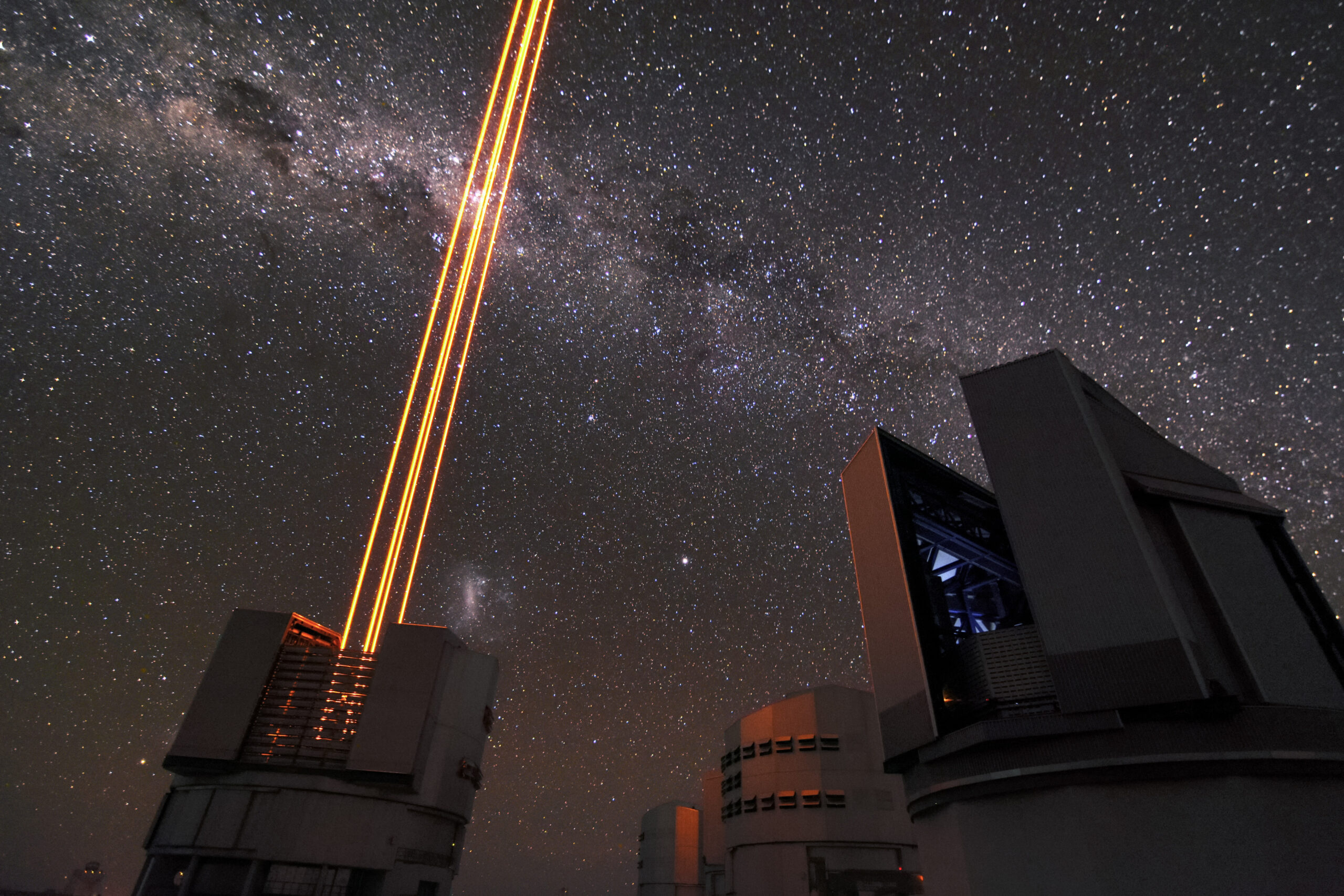
Astronomers fire a powerful yellow laser beam into the sky to create an artificial reference point known as a laser guide star. The laser excites a thin layer of sodium atoms about 90 km above Earth in the mesosphere. These atoms absorb the laser light and re-emit it, producing a glowing spot in the sky that acts like an artificial star.
Because this “star” is created by the telescope itself, astronomers always know its exact position. Once the artificial star is created, the telescope measures how its light is distorted by atmospheric turbulence. A computer then calculates how the atmosphere is bending the light and sends commands to a deformable mirror inside the telescope. This mirror changes its shape hundreds or even thousands of times per second, canceling out the distortion.
As a result, the telescope can produce much sharper images, approaching the clarity of space telescopes.
Improving Ground-Based Telescopes
Without adaptive optics and laser guide stars, ground-based telescopes would suffer from blurred images caused by atmospheric effects. By using lasers, astronomers can achieve near space-quality resolution while operating from Earth’s surface. This technique allows scientists to study distant galaxies, observe stars forming in nebulae, and even image exoplanets around nearby stars.
By creating artificial guide stars and enabling adaptive optics systems, Lasers allow telescopes on Earth to overcome atmospheric distortion and observe the universe with remarkable precision. This technology helps astronomers capture clearer images and make more accurate measurements of distant cosmic objects.

- Your Ultimate Guide to the June Sky Events - May 23, 2026
- Ripples in spacetime and how LIGO proved Einstein right - May 20, 2026
- Hubble Observes A Rare Transitional Galaxy - May 19, 2026